

Easy Drum - Real Music Drum
AVA GAMES
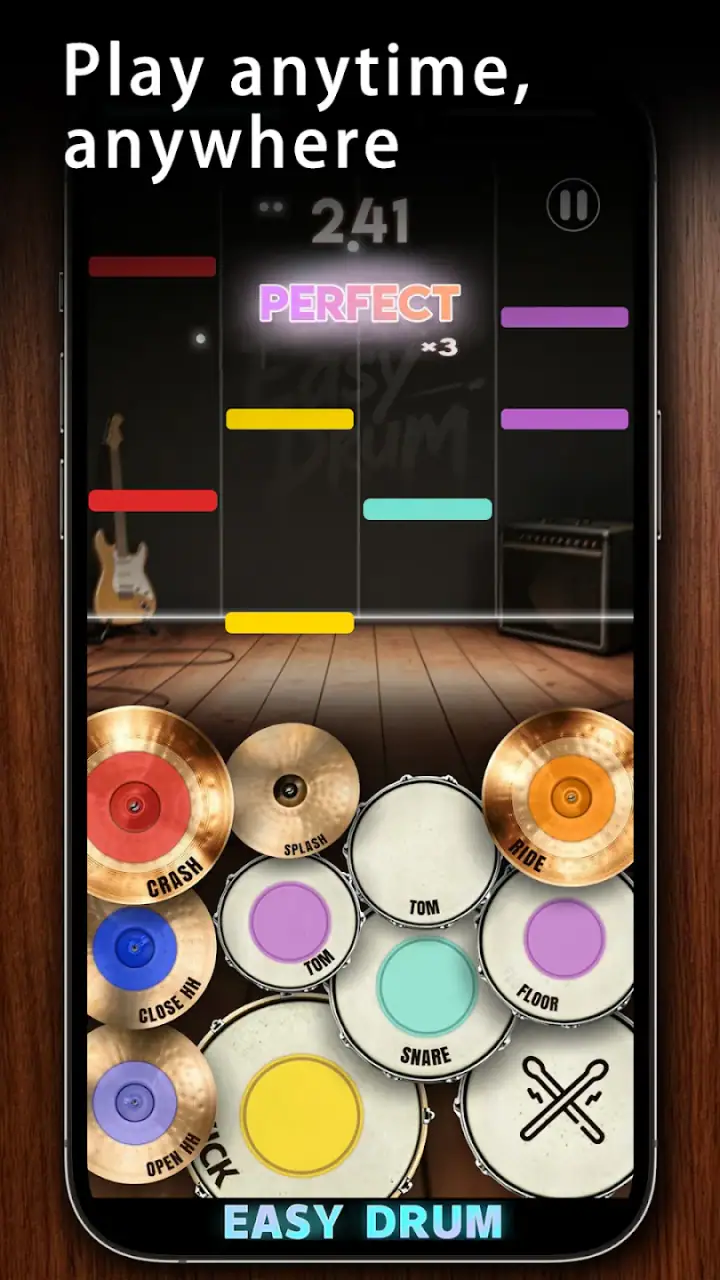
My first few minutes with Easy Drum - Real Music Drum were immediately clear: this is a music game built around tapping along with songs rather than learning a full drum kit. I chose a track, watched the play area, and tried to hit the incoming rhythm at the right moment. The action is simple enough to understand without instructions, but keeping a steady hand becomes surprisingly demanding once the music gets busier.
That straightforward design is the main reason I can see myself recommending it for quick breaks. It does not ask me to build a character, manage a long campaign, or study complicated controls before playing. I open it, choose a track, tap through a performance, see how well I handled it, and decide whether I want another attempt. The cycle is short, readable, and well suited to a phone.
How the drum-game loop feels in practice
The first tap is easy, but timing quickly becomes the real challenge
Easy Drum is a free music game from AVA GAMES, and its central idea is easy to grasp: follow the rhythm and play along with hit tracks. The store summary describes it as a rhythm drum app and game, but that label only tells part of the story. In use, it feels less like a virtual instrument and more like a focused timing test that uses drum sounds and familiar musical structure to make every successful tap feel meaningful.
I like that the entry point is so low-pressure. Someone who has never played a rhythm game can understand the basic goal almost instantly. You are not expected to know drum notation or recognize technical terms. The important skill is listening, watching, and reacting together. That makes it a reasonable choice for casual players, children who enjoy music games, and adults who want something more active than simply pressing play on a song.
The trade-off is that the simplicity leaves little room for players who want a detailed drumming simulation. I would not install this expecting separate kick, snare, hi-hat, and cymbal technique, or a practice environment for developing real percussion skills. The appeal is performance timing, not instrument training. If your goal is to learn how to play an acoustic or electronic drum kit, a dedicated lesson app or a real practice setup would be a better fit.
Related News






Feedback makes each successful sequence feel earned
The strongest part of the experience is the relationship between action and feedback. I tap, hear and see the result, and immediately know whether my timing matched the song. That instant response gives the game its energy. A good sequence creates a small feeling of control, while a missed beat breaks the flow and makes me want to try the same passage again with more attention.
This is where the game works better than a basic music player with a drum overlay. Listening alone is passive; here, the track gives me a moving target. I have to anticipate the next beat instead of reacting only after it arrives. The result is a compact concentration exercise. Even a short session can make me put my phone down feeling that I actively did something rather than merely consumed content.
For the best experience, I found it useful to treat the first attempt on a song as a reading pass. Instead of chasing a perfect result immediately, I listen for the repeating pattern and notice where the rhythm changes. On the next run, I can focus on those transitions. This small adjustment is more effective than tapping harder or faster, because rhythm games usually punish rushed reactions more than they punish cautious ones.
Gallery
Another practical tip is to play with a consistent grip and keep the tapping area comfortable before starting. When my hand shifts between attempts, I tend to blame the song for mistakes that actually come from awkward positioning. A stable posture helps separate genuine timing problems from simple finger fatigue, especially during repeated runs.
Why a miss encourages a reset instead of ending the fun
The reset is central to the appeal. A run can go well for a while and then fall apart on one difficult phrase. Rather than making that failure feel like a major setback, the short format makes restarting feel reasonable. I already know the song’s shape, I have identified the troublesome moment, and I have a clear reason to try again.
This creates a useful loop: action, immediate feedback, a sense of progress when the timing improves, then a reset that turns mistakes into information. The reward is not only a score or a completed track. It is also the feeling that my next attempt can be cleaner because I now understand what went wrong.
That design works particularly well in everyday situations. Imagine waiting for a friend outside a café or taking a short break between tasks. I can play one track without committing to a long session. If I miss a section, I can either restart while the pattern is fresh or close the game and return later. The game respects that kind of fragmented play better than music titles that require long progression sessions.
There is a possible downside for players who dislike repetition. The same failed section may become the main focus of several attempts, and the satisfaction depends on enjoying gradual improvement. If you want constant novelty, a rhythm title with a large campaign, changing mechanics, or broader multiplayer systems may hold your attention longer. Easy Drum is more about refining a compact performance than moving through a deep adventure.
The reward is personal improvement, not a complicated progression system
What keeps me playing is the immediate comparison between attempts. A song that felt chaotic at first becomes readable after I have heard its pattern. I begin to recognize the point where I usually rush, the pause that makes me tap too early, or the transition that needs a calmer hand. That kind of improvement is modest, but it is tangible.
The game also benefits from music doing much of the emotional work. A successful run feels more satisfying when the taps sit naturally inside the track. The sound is not just decoration; it gives context to the timing. When I am in sync, the performance feels like participation in the song. When I am late, the mismatch is obvious enough to motivate another attempt.
I would describe the reward structure as best for players who enjoy mastery in small steps. It is not the right choice if you need a large collection of unlockable systems to stay interested. There is pleasure in improving a passage, but the game’s basic premise remains focused. That focus is a strength for short sessions and a limitation for anyone seeking a broad, long-term progression experience.
Because the game is free, it is easy to test without making an upfront commitment. It carries a Everyone content rating, which makes it suitable for a broad audience in terms of stated age classification. Optional in-app purchases range from $0.99 to $5.99 per item, so I would still check the purchase flow before handing the phone to a child. The free entry is helpful, but the presence of optional spending means it is worth keeping normal device purchase controls in place.
What the current version means for everyday use
The current release is version 1.12.0, and the game supports devices running Android 7.0 or later. That is useful information for anyone using an older phone, although compatibility alone does not guarantee that every device will feel equally comfortable. Rhythm games depend heavily on responsive touch input, so a phone with a sluggish screen or noticeable audio delay can make accurate play frustrating even when the app itself opens normally.
For that reason, I would test a simple track before judging my ability. If every tap feels consistently late, the problem may be the device, headphones, or general audio timing rather than my rhythm. Playing through the phone speaker can be a sensible first check. If the response feels better without wireless audio, the connection may be introducing delay. This is an important trade-off for a timing game: better sound quality is not always more useful than immediate response.
I also prefer to begin with a short, attentive session rather than playing while doing something else. The game looks casual, but its main challenge depends on concentration. It is not ideal as background entertainment while answering messages or watching another video. The more attention I give the beat, the more rewarding the feedback becomes.
Who will enjoy it, and who should choose another rhythm game?
Easy Drum is a good match for someone who wants a quick music-based challenge with controls that can be understood immediately. It suits casual players, people who enjoy repeating a song to improve timing, and anyone looking for a compact way to make a break feel more interactive. It can also work as a gentle introduction to rhythm games because the basic action does not require previous experience.
I would be more cautious about recommending it to serious drummers, rhythm-game experts, or players who expect extensive customization. The game’s identity is built around accessible tapping and song performance. It does not replace a metronome, a drum lesson, or a full rhythm title with a deep competitive structure. If your priority is technical practice, choose a tool that measures tempo and technique directly. If your priority is a large, varied progression system, choose a broader game.
It is also worth considering your tolerance for retrying. The most satisfying moments come from turning a missed sequence into a better one. Players who find repeated attempts relaxing may appreciate that design. Players who want every session to introduce a new mechanic may feel that the loop becomes narrow sooner than expected.
How it compares with ordinary alternatives
Compared with simply listening to music, Easy Drum adds participation and focus. Compared with a virtual drum kit, it offers a clearer game objective and less freedom. A virtual instrument lets me experiment with sounds and patterns, but it may not provide the same immediate sense of chasing a target. A lesson-oriented app can teach more useful real-world technique, yet it usually asks for more patience and structured practice.
That middle position is the game’s clearest identity. It is more active than a music player, more approachable than a serious instrument simulator, and less demanding than a full training program. I would choose it when I want the mood of drumming without needing equipment or a lesson plan. I would not choose it when I need accurate musical education or a large social competition layer.
The comparison also explains why the short-session format matters. A conventional music game may be designed around extended progression, while this one is easy to pick up for a single performance. The reset is not a punishment that sends me through a long menu structure; it is part of the rhythm of play. Finish, assess, restart, improve, and stop whenever the break is over.
My final take on the repeat-play loop
After spending time with it, I see Easy Drum as a focused rhythm game whose best quality is clarity. The action is obvious, the feedback arrives quickly, and the reward comes from feeling a song become more manageable through practice. Its loop has a satisfying shape: I make a move, receive an immediate musical response, notice improvement, reset after a miss, and begin again because the next attempt feels genuinely informed.
Its limitations are just as clear. It is not a complete drum simulator, not a substitute for lessons, and not necessarily deep enough for players who need a long progression system. The optional purchases also mean families should pay attention to device purchase settings, even though the game itself is free to start and rated for Everyone.
Still, I think AVA GAMES has chosen a sensible scope. With an average rating of 4.6 from over 700 ratings and more than 100 thousand installs, it has attracted a solid audience without needing to be presented as something larger than it is. My recommendation is simple: try it if you want short, music-driven sessions built around timing and retrying. Skip it if your idea of a drum app involves detailed technique, open-ended beat creation, or a substantial campaign. For the right player, the next session begins for one convincing reason: the last beat you missed still feels close enough to get right.
FAQs for Easy Drum - Real Music Drum
What is Easy Drum - Real Music Drum?
Easy Drum - Real Music Drum is a virtual drumming app that turns your Android or iOS device into a playable drum kit. It is designed for beginners, casual players, and music fans who want to tap different drums and cymbals directly on the screen. The app offers a simple way to practice rhythms, experiment with beats, or play along with music without needing a physical drum set.
Is Easy Drum - Real Music Drum suitable for beginners?
Yes, the app is aimed at users of different skill levels, including people who have never played drums before. Its touch-based layout makes it easy to start by tapping individual drums and cymbals, while more experienced users can work on timing and coordination. However, the screen size of your device may affect comfort, especially when attempting faster patterns or using several virtual drums at once.
Can I use Easy Drum - Real Music Drum to practice real drumming skills?
Easy Drum - Real Music Drum can help with basic rhythm, timing, hand coordination, and familiarity with common drum sounds, but it should not be considered a complete replacement for a real drum kit or electronic drums. Touch controls do not provide the same rebound, dynamics, or physical feedback as real drumsticks. It is best used as a convenient practice and entertainment tool.
Does Easy Drum - Real Music Drum work without an internet connection?
The core drumming experience may be available without a continuous internet connection, which makes the app convenient for quick practice sessions while traveling or when mobile data is limited. Nevertheless, some features may depend on the version installed, device permissions, advertisements, updates, or external music playback. It is recommended to open the app once after installation and test its main functions offline.
Is Easy Drum - Real Music Drum free to download and use?
The application can generally be downloaded without an upfront purchase, but the exact business model may vary depending on the platform and current version. Free versions of music apps commonly include advertisements or optional purchases, so users should check the Google Play Store or Apple App Store listing before downloading. Also review requested permissions and in-app purchase details if they are displayed.
Pros
- Responsive pads make finger drumming feel natural and enjoyable.
- Simple layout lets beginners start playing without a long tutorial.
- Useful for practicing rhythms quietly with headphones.
- Works well for quick musical sessions on the go.
- Multiple drum sounds add variety to basic beat creation.
Cons
- The free version may include frequent ads during use.
- Small screens can make precise pad tapping difficult.
- Sound options may feel limited for experienced drummers.
- Advanced recording and editing tools are not very extensive.
- Audio latency can vary depending on the device and settings.


